

Living with difficult things when there are no quick fixes

Updated: May 22

We all love to solve a problem, find a resolution, forge a way forward, get things sorted, relieve our or someone else's suffering, and move through to the other side of difficulties.
But sometimes, often in fact, life just isn't that simple.
Sometimes there is no quick relief.
There are things that are not going away any time soon, if at all.
And that's hard to live with.
It's a tough one to accept, to get our head and heart around, and to navigate.
It sucks!
I wonder what springs to mind from your own life when you read this title. I'm sure everyone must be able to relate to it in some form, albeit to greater or lesser degrees.
But people to do find ways to live with difficult things, they have no choice but to, and there are always things we can do to help. So let's explore some of those together now.
I could give tips, but you know yourself and your situation better than me, and finding your own answers is always more effective than being told what to do. So here are some questions for you. Taking time to think about some answers could be a step towards.....
Possibly pick out a couple of questions that particularly stand out to you. Make a note of them on your phone or on a piece of paper to ponder further.
I've split it into 4 sections, breaking it down into more detail in each one. Simplified the 4 questions would be:
What practical things can you do to help (surrounding the actual difficult thing)?
What practical things can you do to help you cope?
How can you look after yourself emotionally and physically?
Are there any tweaks you could do to improve your mindset?
Practical things you could do to help (surrounding the actual difficult thing)

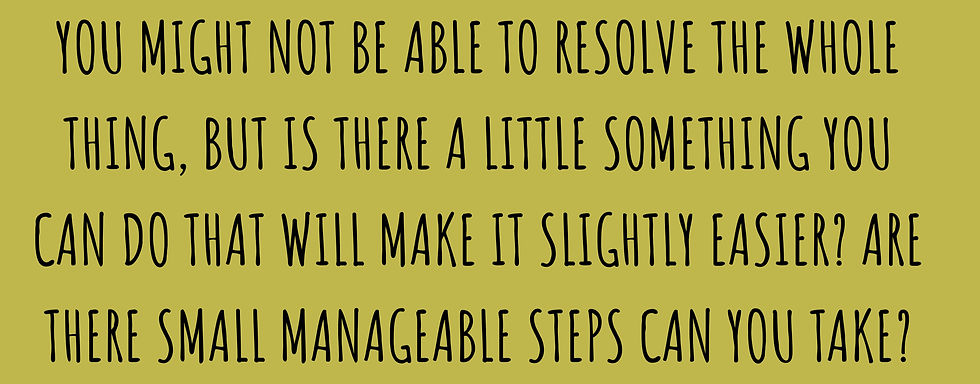
Small wins add up and count for more than we give them credit for. It also gives you back a bit of control. To feel you are doing something, however small, is far better than the hopelessness of doing nothing. It takes us to the famous question: 'How do you eat an elephant?', with the answer being: 'One mouthful at a time'.

Whilst you are slowly chipping away with the little things, there may not be any big quick wins, but sometimes there might be a longer term goal that could be worth investing in that will help in the long run. It can be overwhelming to think of something taking so long, but time passes by regardless, and at the end of that period of time you could have got yourself in a better place as a result of the investment. Play the long game.

Many things are beyond our control. This can be a very depressing fact, and incredibly frustrating and anxiety producing to live with. The emotional side of that reality can be hard to deal with (we'll come back to that), but in terms of practicalities, it can be really helpful to separate out and identify what is within our control and what isn't.
Practical things you can do to help you cope

It's important to find ways to live well alongside your difficulty reality.
Sometimes it is about sustaining rather than fixing.

This can be big or small things.
I'm all for making the most of the simple pleasures in life, pondering them and doing them. They can be easier to access too than the bigger things, but can be equally beneficial.
At my lowest moments I've tried to have a rule to say yes to things I'd enjoy rather than giving into the reasons why I shouldn't that my mind tries to throw at me.
If you've got it in you, then try to arrange things that will do you good.

For example, good sleep, exercise, healthy nutrition, and drinking plenty of water are mostly free yet are so powerful in terms of helping us to feel better.

Identifying what zaps your energy is a good start. Certain people; conversations; social media etc.
Trying to balance out draining things with things that restore, uplift, encourage and strengthen us can be the things that gets you through.
Trying to keep to the minimum how much you bury your head in the sand, procrastinate or let overwhelm take over. Easier said than done I know. But when things pile up it gets worse. Sometimes the best form of self-care isn't a bubble bath and chocolate cake, it's keeping on top of jobs so they don't get too big to tackle.
Looking after yourself emotionally and physically


Difficult things are difficult things. It's OK to allow yourself to feel the emotions that come up.
If you fear allowing your emotions will mean them completely taking over you and getting lost in them, you can try allowing yourself certain limited times. Julia Samuels, on her work with grief, advocates for giving yourself times where you focus on the loss, and times where you give yourself a break from it, and being intentional about both.

People can have a negative view on self-compassion, giving it a more negative tone labelling it as navel-gazing, self-pity, being self-absorbed, making excuses, or airy-fairy.
Little do they know what a powerful resource it is. It is amazing what strength can arise in us when we take some time to give ourselves the self-compassion we deserve.

Our own needs and wants can get lost as we are trying to keep our head above the water and have little time, energy, finances, or motivation.
It's especially hard if your struggle is linked with supporting someone else in some way.
Again, even starting with the little things can really make a difference.
In order to be of use to others, and to yourself, you do need to invest in your own needs and wants too.
It may be an overused analogy, but we all need reminding sometimes, that as stated in a pre-flight briefing - put your own oxygen mask on before helping others. Prioritising your own well-being ensures you have capacity to care for others.
It is a daring act to honestly ask ourselves what we need and what we want.

Practical help, advice, a listening ear, some financial help, a lift etc.
Draw on friends, family, neighbours, colleagues, other people you come into contact with, social media, support groups, Google etc.
Professional help: there are people with extensive training and knowledge about things that might be useful to you. We can't possibly be expected to know everything or solve everything on our own. There is help available.
It's a bit hard to give examples without knowing your situation, but things like counsellors, doctors, coaches, handymen, plumbers, neurodiversity specialists, financial advisors etc.
What might you benefit from?
Mindset

It can be helpful to look at things from a different angles.

Sometimes, if we haven't come to a place of acceptance, then we spend the majority of our energy wrestling with the fact that this isn't what we want and how hard it is, rather than finding a way to get our head and heart around it and work with what we've got.
Once we move to a place of acceptance we have more energy to put towards the task of how we live with this reality in the best possible way.

Remember comparison is the thief of joy!
The only time comparisons can be useful are if you let them inspire, fuel hope, and motivate you.
We all have our own journey.
We have different upbringings, family situations, challenges, obstacles, set of resources, privileges, capacity, intellect, energy levels, financial means, health, values, wounds, and circumstances. How can the combination of those things be measured or compared?
Drop the comparisons and work out what is right for you.

These can be put on you by others or by yourself.
Thoughts or sentences beginning with the word 'should' are always a bit of an alarm bell and can help identify expectations that might need adjusting.
Boundaries, boundaries, boundaries!
If you are noticing 'I (or you) should....', take a pause. Where does the 'should' come from? Do you actually want to or need to do it? If not then where is the pressure of 'should' coming from? Do you have time and capacity for it? Is it in line with your values? Is it the priority at the moment?
Is there a different response to the thing you 'should' be doing? Could you not do it now, or at all? Could you delegate it? If it does still need doing could you find a way that views it in a more positive way?

There's a 3 step model which can aid this: Catch it (notice your inner dialogue). Check it (challenge the thought). Change it (replace the thought).
Some examples could be:
'I can't/I don't want to/there are other more pressing needs at present/I haven't got the time, energy or capacity for this at the moment, sorry' could replace 'I should...'
'I get to' rather than 'I have to'.
'I learnt from that experience and can improve next time' rather than 'I failed'
'I can have a go' rather than 'I'm no good at that'
'I'm doing my best' rather than 'They are doing better than me'
'There are always things to be grateful for' rather than 'My life is shit'
'There are opportunities to....' rather than 'I'm trapped and stuck'.

We can't always change the difficult things we have to live with. If we can manage to somehow hold on to who we are and our values through it then we are winning.
People do all sorts of things to get through, granted some are more healthy and helpful than others, but let's take a minute to give respect to the ways people find, with the resources they've got available to them. I frequently stand in awe of people's creative ways to cope. The mind is incredible. Our instinct for survival is too.
I'll leave you with this parting quote. A message of ownership and hope. In Victor Frankl's book 'Man's Search For Meaning', a book sharing his experiences in a concentration camp in Auschwitz, he says:
"Everything can be taken from a man but one thing: the last of the human freedoms - to choose one's attitude in any given set of circumstances, to choose one's own way."
There are loads of counsellors out there that would love to walk with you on your personal journey. A quick Google search will help you find ones local to you or that specialise in an area that would be helpful to you. Counselling Directory, and BACP are great places to find a counsellor that's right for you.
I am one of them and my name is Ruth.
If you're struggling to hold on to hope at the moment and would like some support, please reach out at: thehoperoomcounselling@gmail.com or through my website: https://www.thehoperoom.co.uk/


Comments